
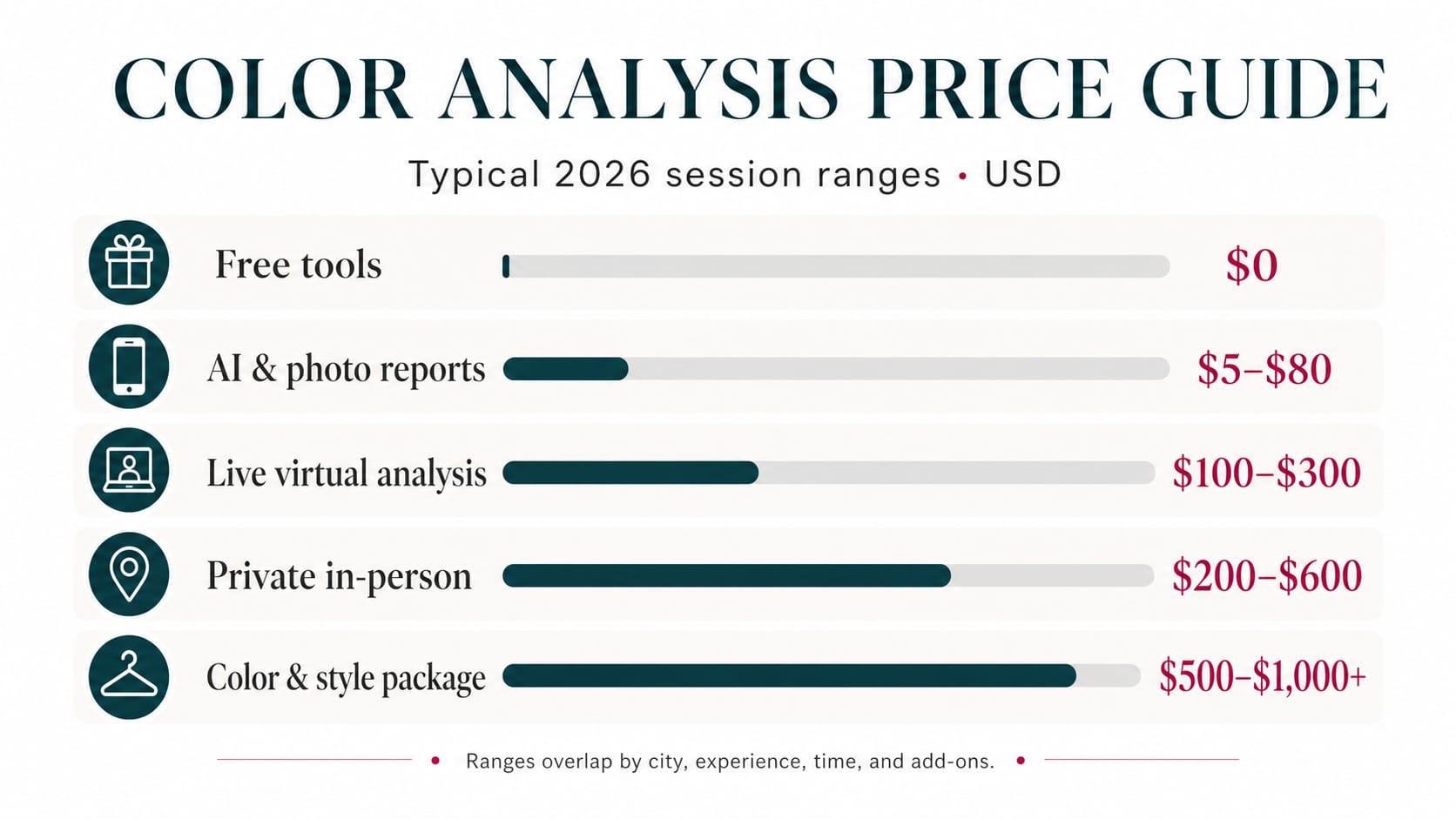
Color analysis cost at a glance
| Format | Typical 2026 cost | Session time | Worth it for | Main tradeoff |
|---|---|---|---|---|
| Free quizzes and filters | USD $0 | 2 to 10 min | Curious, just playing around | High error rate; no nuance |
| AI tools and apps | USD $5 to $50 | 2 to 5 min | A rough starting point | Still-image limits |
| Photo-based online consultants | USD $30 to $80 | 3 to 7 day turnaround | No-call budget analysis | Accuracy depends on photos |
| Virtual analysis with a real analyst | USD $100 to $300 | 60 to 90 min | Budget human analysis | Screen color variation |
| In-person with a trained analyst | USD $200 to $600 | 2 to 3 hours | Most US buyers | Costs more and requires travel |
| Franchise private color (color only) | USD $300 to $450 | 2 to 3 hours | Polished process, brand familiarity | Price still varies by stylist |
| Franchise color and style day | USD $600 to $800 | Half day or more | Color plus wardrobe guidance | More than color alone |
| Group color session | USD $175 to $300/person | 2 to 3 hours shared | Friends booking together | Less individual attention |
| Color, style, and shopping packages | USD $500 to $1,000+ | Half day or more | Full wardrobe overhaul | Overkill for color alone |
Prices listed below are sourced from publicly available pages as of early 2026 and may have changed. Verify current pricing directly with the analyst or studio before booking.
Free options: USD $0
Free color analysis tools give you a guess. TikTok filters, quizzes, and free photo tools can introduce the basic seasonal language, but they should not drive shopping decisions.
The problem is the evidence. Lighting changes the result. Camera processing changes the result. The same person can take two photos five minutes apart and look warmer, cooler, softer, or brighter.
Use free tools if you have never thought about color analysis before. Do not rebuild your wardrobe from a free result.
AI tools and apps: USD $5 to $50
AI color analysis apps usually cost less than a professional appointment. HueCheck lists a USD $9.99 web option, while MySeason lists a EUR €5.99 complete analysis. Some apps use subscriptions or charge more for try-ons and shopping tools.
What you get is a polished version of the free quiz. The app may return a season, palette, PDF-style report, virtual try-on, or shopping suggestions.
The fundamental limit is not the camera. AI sees a frozen image, so it cannot observe how a color changes your skin clarity, shadow depth, or eye brightness in real time. Camera color shift compounds the problem, but it is not the core issue.
Photo-based online consultants: USD $30 to $80
Photo-based color analysis is the budget tier between apps and live sessions. You submit photos, wait a few days, and receive a written season result or PDF report.
This format can work when the analyst gives strict instructions. Expect to provide 4 to 8 photos in natural light, without filters, heavy makeup, or colored backgrounds. Hair should be pulled back if it is dyed or visually dominant.
The tradeoff is context. A photo-only analyst cannot watch colors change on your face in real time. Live follow-up questions are rarely included at this price.
Virtual analysis with a real analyst: USD $100 to $300
Virtual color analysis gets serious when a trained human analyst reviews your photos, compares colors, and explains the result. The format can work well when the process is strict.
Price depends on experience, whether a live call is included, how much follow-up you get, and whether the package includes makeup, hair color, metals, or printed swatches.
A current example is The Color Guru, which lists USD $169 for its Essential package, USD $249 for Plus, and USD $795 for Premium. The lower two packages sit squarely in the common virtual analyst range.
Virtual is often the best value when you want a trained human eye without travel. It is not always the cheapest path people actually book. In the US, many in-person private color sessions now sit closer to USD $250 to $400.
Ask what is included before booking. A USD $200 session with a swatch fan and makeup guide can be better value than a USD $150 session where both are paid add-ons.
Common add-ons include:
- Physical swatch fan, especially for virtual sessions
- Personalized makeup guide
- Hair color consultation
- Wardrobe audit or shopping list
- Follow-up call after the appointment
In-person with a trained analyst: USD $200 to $600
In-person color analysis is the traditional accuracy standard. You sit under controlled lighting while an analyst holds physical fabric drapes near your face and watches how your skin reacts.
Independent analysts often charge about USD $250 to $400 for a core session, with higher prices in expensive cities. Innate Color Analysis lists USD $395 for an in-person 12-tone session and USD $225 for virtual.
In-person is worth the extra money if your coloring is neutral, olive, unusual, or confusing. Physical drapes and real-time observation catch details photos miss.
City pricing varies. Analysts in New York City, Los Angeles, San Francisco, Toronto, Vancouver, and London often charge more than analysts in smaller markets. A session under 90 minutes is not automatically bad, but it is worth asking what gets skipped.
Franchise private color: USD $300 to $450
Franchise and studio brands often price private color-only sessions in a tighter band than independents. Across US House of Colour stylists with published service menus, adult private color commonly clusters around USD $300 to $375, with most color-only appointments under USD $450.
Current examples include House of Colour Kansas City at USD $395 for a private color session, House of Colour UK at GBP £240 for one-to-one colour, and House of Colour York at GBP £260 to £280 for one-to-one colour.
Brand recognition and a rehearsed process can be worth paying for. They do not automatically buy a more accurate result than a careful independent analyst.
Franchise color and style days: USD $600 to $800
Color and style combination days are a different product. US House of Colour menus that list a color-and-style package often land around USD $615 to $750. That price buys wardrobe guidance on top of the palette, not a more expensive version of color alone.
If you only need your seasons, book private color. If you also want outfit formulas, shopping rules, or a longer style day, the package tier can make sense.
Group sessions: USD $175 to $300 per person
Group color analysis lowers the per-person cost by sharing the analyst's time across friends, families, or a small event. It is often called a color party or group draping session.
In sourced US listings, a full shared or duo session usually lands around USD $175 to $300 per person. Examples include Colorbook at USD $250 each for groups of two to five, Huephoric Chicago at USD $195 to $300 depending on group size, Omyo Color Studio at USD $175 to $210 per person for two or three clients, and House of Colour Kansas City at USD $295 per person in a group against USD $395 private.
Mini party formats and larger groups can sit under USD $175. Premium city groups and packages with makeup or style work can sit above USD $300. Directory low ends that look like USD $80 to $150 are often children sessions or re-rates, not adult group draping.
Group sessions work best when everyone wants a practical palette and no one needs a long discussion about hair color, makeup, or wardrobe strategy.
All-in-one packages: USD $500 to $1,000+
All-in-one packages combine color analysis with style consulting, wardrobe edits, shopping, makeup, or longer expert calls. This is wardrobe-overhaul pricing.
The Color Guru's Premium package is USD $795 and includes photo analysis, color cards, report, makeup cards, a hair consultation, and a 45-minute founder call. House of Colour UK stylist examples show all-in-one color and style days around GBP £650 to £660.
This tier makes sense if you are changing careers, rebuilding after a body change, or feel completely stuck on style. If you just want to know your best colors, it is overkill.
The 4-season vs 12-season price difference
A four-season analysis assigns you to Spring, Summer, Autumn, or Winter. A 12-season analysis adds sub-seasons like Light Spring, Soft Autumn, Deep Winter, and Cool Summer.
Analysts who use 12-season or 16-season systems usually charge more because the process takes more training, more comparison drapes, and more explanation. The premium is worth considering if your coloring is muted, neutral, olive, or hard to place.
No universal license exists for color analysts. A named training source is more useful than a claim like "certified color expert" with no program attached.
What makes the price go up or down
Location
NYC, LA, San Francisco, Toronto, Vancouver, and London usually price higher than smaller markets.
Analyst experience
A long-practicing analyst with a clear portfolio usually charges more than a newly certified analyst.
Session length
A 45-minute basic session costs less than a 2 to 3 hour comprehensive appointment.
Deliverables
Makeup, hair color, metals, printed swatches, physical fans, and follow-up calls all push the price up.
Color system
A 12-season or 16-season result usually costs more than a broad four-season result because the process takes more training and time.
Group sessions
Booking with friends often lands around USD $175 to $300 per person for a full shared session. Larger parties and mini formats can run lower. Premium city groups can run higher.
When does color analysis pay for itself?
Color analysis pays for itself when the palette prevents enough wrong-color purchases to offset the session fee. The math is personal, so use your own annual clothing spend instead of a generic average.
A simple test works: multiply your annual clothing spend by the share of purchases you think the palette would prevent. If you spend USD $1,500 per year and a palette prevents 20% of future mistakes, the avoided spend is USD $300 per year.
| Analysis cost | Example annual clothing spend | Break-even if 20% is redirected | Break-even if 25% is redirected |
|---|---|---|---|
| USD $200 virtual basic | USD $1,500 | 8 months | 6 months |
| USD $325 franchise or in-person color | USD $1,500 | 13 months | 10 months |
| USD $400 in-person independent | USD $2,500 | 10 months | 8 months |
| USD $700 color and style package | USD $3,000 | 14 months | 11 months |
These examples assume you actually use the palette when shopping. An unused palette has no break-even point, even if the analysis was accurate.
Is color analysis worth the money?
Color analysis is worth the money when the result changes what you buy. For most people, that means the USD $250 to $400 tier with a trained analyst, not the cheapest app and not the most expensive image-consulting package.
The result is not just a color list. It is a filter you apply at the point of purchase: does this work with my palette? That filter reduces impulse buys in pretty colors that never leave the closet.
It is worth it if
- You buy clothes that sit unworn.
- You have never figured out which colors flatter you.
- You are rebuilding your wardrobe or changing careers.
- Your old colors stopped working as your hair, contrast, or skin changed.
- Your coloring is neutral, olive, unusual, or hard to match.
It is probably not worth it if
- You already know what works on you.
- You wear mostly neutrals and do not care about color.
- You spend under USD $600 per year on clothing.
- You would ignore the palette after the appointment.
- You need a uniform or capsule with very limited color variety.
- You have not figured out the styles you actually want to wear.
How to vet an analyst before paying
Ask for the analyst's training background. A named program is better than vague experience.
Ask whether the result includes a sub-season or only Spring, Summer, Autumn, or Winter.
Ask exactly what is included in the base price before comparing analysts.
Look for sample palettes, specific testimonials, or before-and-after examples.
For virtual sessions, ask for natural-light photo requirements before the call.
How to get a good deal
Book a virtual analyst with strong reviews. A USD $200 virtual session from a careful analyst can beat a more expensive weak in-person session.
Look for slow-season pricing. January and late summer are common quiet periods for style services.
Ask about group bookings. Two or three friends often pay about USD $175 to $300 per person, which can undercut a private session without dropping into app pricing.
Skip the upsells first. The core analysis matters more than wardrobe planning, shopping help, or a long follow-up call.
Use the first result before paying again. Wear the palette for a few months before deciding it failed.